

privacy-focused VPN: 7 Powerful Reasons to Avoid Privacy Risks 2025
Why You Need a Privacy-Focused VPN
A privacy-focused VPN is a virtual private network service that prioritizes user privacy through strict no-logs policies, open-source applications, and strong encryption to protect your online activities from tracking and surveillance.
Quick Answer: Privacy-Focused VPN Essentials
- Purpose: Encrypts your internet traffic and hides your IP address
- Key Features: No-logs policy, open-source clients, strong encryption
- Benefits: Prevents ISP monitoring, bypasses censorship, protects on public Wi-Fi
- Top Providers: Look for services with verified independent audits
- Limitations: Cannot provide complete anonymity or protect against all tracking
Every time you browse the web, your digital footprint is tracked, logged, and often sold to the highest bidder. Your IP address serves as an online identifier that can be used to map your activities across the internet. As one privacy expert puts it: “What you do online can be tracked by organizations you may not know or trust and become part of a permanent record.”
Privacy-focused VPNs differ from standard VPN services by emphasizing transparency, minimal data collection, and proven security practices. While regular VPNs might claim privacy benefits, the best privacy-focused providers:
- Maintain strict, independently audited no-logs policies
- Operate open-source applications for public code review
- Accept anonymous payment methods like cash or cryptocurrency
- Use cutting-edge encryption protocols like WireGuard
- Undergo regular independent security audits
While a VPN improves your privacy significantly, it isn’t a silver bullet. As noted in research by Privacy Guides: “A VPN improves privacy but does not hide browsing habits completely. For anonymity, use the Tor Browser.”
Think of a privacy-focused VPN as your first line of defense in an increasingly invasive digital landscape. Whether you’re concerned about ISP monitoring, public Wi-Fi vulnerabilities, or government surveillance, a properly configured privacy VPN creates a secure tunnel for your internet traffic.
Privacy-Focused VPN Explained
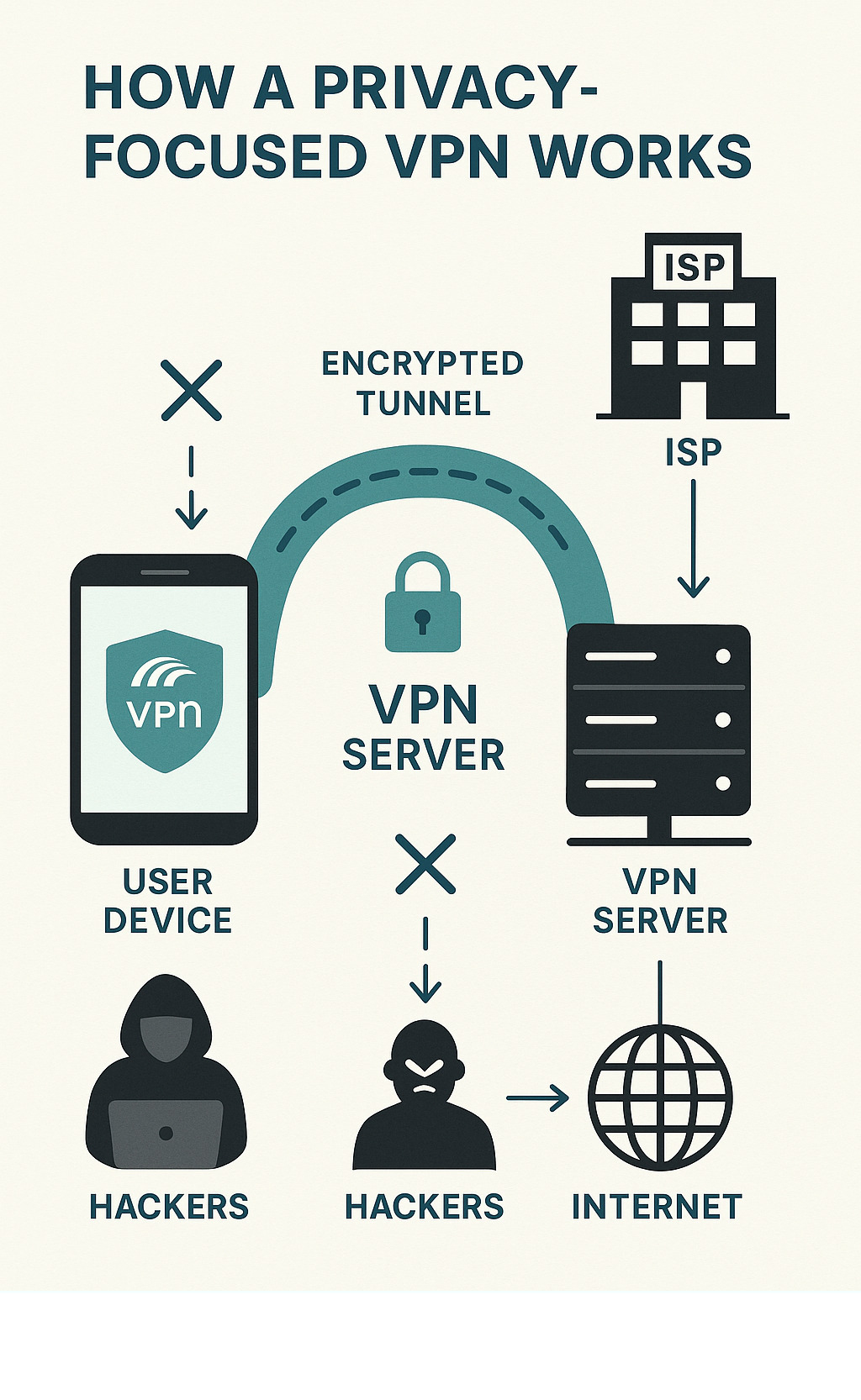
Imagine wrapping your internet connection in a protective bubble that shields your online activities from prying eyes. That’s essentially what a privacy-focused VPN does – it creates an encrypted tunnel between your device and the internet, routing your traffic through servers that mask your real IP address and location. Unlike standard VPNs that might boast about their streaming capabilities or massive server networks, privacy VPNs are laser-focused on one mission: protecting your data from surveillance and tracking.
In today’s digital landscape, the threats to your privacy are numerous and growing. Your internet service provider (ISP) is likely monitoring and logging your browsing habits. Government surveillance programs operate in many countries. Data brokers make billions collecting and selling your information. Hackers lurk on public networks, ready to intercept unprotected traffic. And websites and advertisers track your every click to build detailed profiles of your behavior.
As many privacy experts simply put it: “Your IP address is used to identify you, track you, and map your online life.” By masking this digital identifier, a privacy-focused VPN disrupts this invasive cycle, preventing companies and agencies from creating detailed profiles about what you do online.
When you use a privacy-focused VPN, you gain several powerful privacy protections. Your real IP address becomes hidden, making it much harder for anyone to track your location or identity. Your data gets wrapped in strong encryption (typically AES-256), which prevents eavesdropping on your activities. Your ISP can no longer monitor which sites you visit or what content you access. You can bypass censorship imposed by governments or organizations. And perhaps most practically, you gain essential protection when using public Wi-Fi at places like cafes and airports.
Privacy and anonymity aren’t the same thing. A VPN provides privacy by encrypting your traffic and masking your IP, but as many privacy experts candidly acknowledge: “VPNs are useless at achieving true anonymity.” For complete anonymity, you’d need additional tools like Tor.
Scientific research on surveillance capitalism has revealed how our online behavior is increasingly harvested as a commodity. A privacy-focused VPN serves as your personal shield against this pervasive data collection ecosystem.
Privacy-Focused VPN vs Standard VPN
Not all VPNs deserve the “privacy-focused” label. The differences between privacy-centered services and standard VPNs can be substantial and worth understanding before you make a choice.
True privacy-focused VPNs maintain strict no-logs policies that have been verified by independent auditors. Their applications are open-source, allowing security experts to examine the code for backdoors or vulnerabilities. Many use RAM-only servers that physically cannot store data long-term. They offer anonymous payment options like cash or cryptocurrency. They regularly undergo security audits and maintain transparent ownership structures. And their marketing focuses primarily on privacy features rather than streaming capabilities.
Standard VPNs, by contrast, often fall short in these areas. They might log connection data or metadata. Their software is usually proprietary and closed-source. They typically use traditional servers that could potentially store information. Payment options are usually limited to credit cards or PayPal. Their ownership might be opaque, and their marketing tends to emphasize speed, streaming capabilities, and server count above privacy.
As Privacy Guides sensibly points out: “We think it’s better for the security of the VPN provider’s private keys if they use dedicated servers.” This exemplifies how privacy-focused VPNs go the extra mile to ensure your data remains protected.
The most trustworthy providers back up their claims with evidence. For instance, the best services complete multiple third-party audits over time, demonstrating their commitment to verifying security claims rather than just making them.
When to Choose a Privacy-Focused VPN
There are several scenarios where having a privacy-focused VPN isn’t just nice to have – it’s essential.
Public Wi-Fi Networks are notoriously insecure. When you’re sipping coffee at a café or waiting for a flight at the airport, your data is vulnerable to interception by anyone else on that network. A privacy-focused VPN wraps your connection in encryption, keeping your passwords, messages, and browsing private.
Torrenting or P2P File Sharing activities are often monitored by ISPs, who might throttle your connection or forward copyright notices. A privacy VPN prevents your ISP from seeing this traffic, protecting your speeds and privacy.
If you’re traveling to or living in hostile jurisdictions with extensive surveillance or internet restrictions, a privacy-focused VPN can be your digital lifeline, helping you maintain access to uncensored information and communicate freely.
For remote work security, a privacy VPN adds an essential layer of protection, especially when you’re handling confidential company information outside your secure office network.
These aren’t just theoretical benefits. One user shared a real-world example: “A colleague travels to China and uses Camouflage Mode to bypass local VPN blocks.” This shows how privacy-focused VPNs serve as practical tools for maintaining digital freedom in environments where it’s otherwise restricted.

Must-Have Features of a Privacy-Focused VPN
Looking for a privacy-focused VPN that actually delivers on its promises? Let’s cut through the marketing hype and focus on what really matters. Not all VPNs are created equal, and if privacy is your priority, these features aren’t optional—they’re essential.
No-Logs & Audit Trails
The cornerstone of any trustworthy privacy-focused VPN is a genuine no-logs policy. This isn’t just about a promise on a website—it’s about technical implementation and verification.
What does “no logs” actually mean? It means the VPN doesn’t keep records of the websites you visit, when you connect, your real IP address, or how much bandwidth you use for tracking purposes. Without logs, there’s simply nothing to hand over if authorities come knocking.
The most transparent providers back their claims with action. Some VPN services have actually proven their no-logs claims in court when served with legal demands. When they say they have nothing to share, they mean it!
I’m particularly impressed by providers using RAM-only servers. These servers physically can’t retain data when powered off—it’s not just a policy promise but a technical reality. When the server restarts, everything is wiped clean. Now that’s privacy by design!
Regular transparency reports are another good sign. These reports detail how many government requests for user data the company received and—ideally—how they had zero information to provide. It’s like a public accountability system that keeps providers honest.
Open-Source Clients & Protocols
When a VPN provider keeps their software code secret, they’re essentially asking for blind trust. With privacy-focused VPNs, verification beats trust every time.
Open-source applications mean the code is publicly available for anyone to inspect. Independent security researchers can verify that the app does exactly what it claims—no hidden tracking, no backdoors, no funny business. As one privacy researcher put it: “Open-source VPN apps allow independent code audits for transparency.”
The best providers take this even further with reproducible builds. This technical approach allows users to verify that the app they downloaded matches exactly what’s in the public source code—ensuring no malicious code was slipped in during the build process.
WireGuard has become the gold standard protocol in the VPN world, and for good reason. Its smaller code base makes it easier to audit, while delivering faster performance and strong encryption. Some forward-thinking providers have even implemented their own improvements to address WireGuard’s static IP assignment issue.
Anonymous Payment Options
True privacy begins before you even connect to a VPN—it starts with how you pay for the service. After all, what good is encrypted browsing if your payment details link back to your real identity?
The most privacy-focused VPNs offer truly anonymous payment options:
Sending cash in the mail might sound old-school, but some privacy-centered providers accept this ultra-private payment method. No digital trail, no personal information—just an envelope with cash.
Cryptocurrency payments, when implemented properly, offer another layer of privacy. Just be aware that Bitcoin isn’t fully anonymous without additional precautions—Monero offers better privacy protections.
The best approach is refreshingly simple: generate an account number, pay for your subscription, download the app, enter your account number, and connect—no personal info required. No email address, no name, no nothing. That’s privacy from day one.

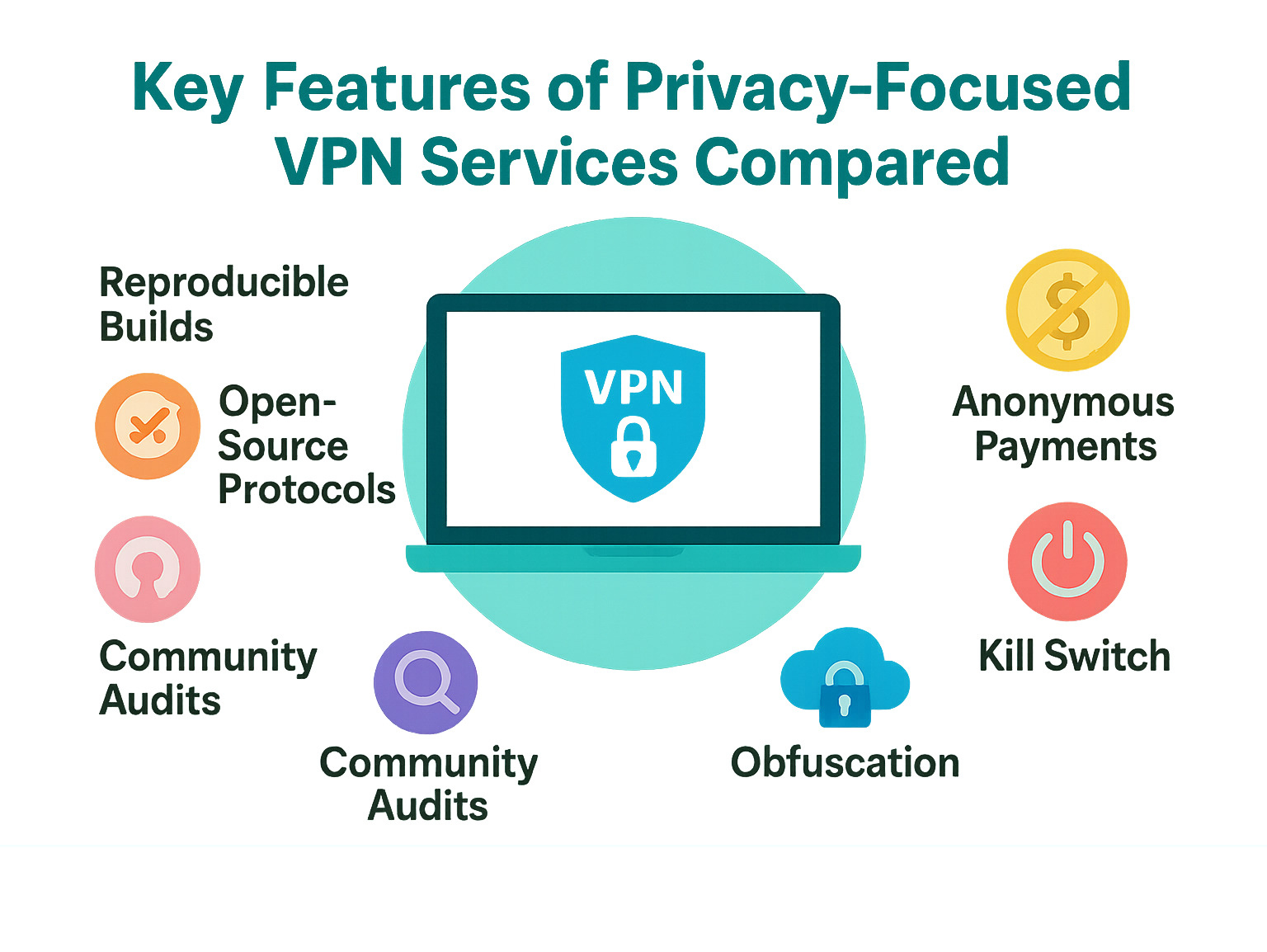
Beyond these core features, every solid privacy-focused VPN should include some critical protective measures. A reliable kill switch automatically blocks all internet traffic if your VPN connection drops, preventing accidental exposure. Robust leak protection for IPv6 and DNS requests ensures your real information stays hidden.
For users in countries with restrictive internet policies, obfuscation features disguise VPN traffic to bypass blocks. Multi-hop connections route your traffic through multiple servers for added privacy, making tracking significantly more difficult. And perfect forward secrecy generates new encryption keys for each session, so even if one session is somehow compromised, your previous and future sessions remain secure.
Don’t overlook the importance of jurisdiction. The country where your VPN provider is based matters significantly because it determines what laws they must follow. Companies based in privacy-friendly countries with strong legal protections and no mandatory data retention laws give you an additional layer of security. As privacy experts explain: “Some countries are particularly good jurisdictions for privacy due to their legal framework.” While many focus on avoiding “14 Eyes” alliance countries, the specific legal protections in place often matter more than these intelligence-sharing agreements.
Limits of VPNs & Complementary Privacy Tools
Let’s be honest – a privacy-focused VPN is a fantastic tool, but it’s not a magic invisibility cloak for everything you do online. Many VPN providers cut through the marketing hype with this refreshing dose of reality:
“Despite what many VPN providers advertise, VPNs are useless (at best ineffective) at:
– Achieving true anonymity
– Preventing Google/Facebook tracking
– Stopping profiling by social networks
– Protecting against endpoint security threats”
Think of your privacy-focused VPN as a secure tunnel for your internet traffic – but that tunnel has entrances and exits that remain vulnerable. Your digital life exists beyond just your IP address.
Browser fingerprinting is a perfect example of this limitation. Websites can identify you through the unique combination of your browser settings, installed fonts, and hardware – even with your IP address hidden behind a VPN. It’s like wearing a disguise but still using your distinctive signature.
Got malware on your device? Unfortunately, your privacy-focused VPN can’t help you there. Any endpoint malware can capture your data before it even enters that secure VPN tunnel – kind of like a spy reading your letter before you put it in a secure envelope.
And let’s talk about social media tracking. When you’re logged into Facebook, Google, or other platforms, they track your activities across the web regardless of your IP address. Your VPN might hide where you’re connecting from, but not who you are once you’ve logged in.
Using your phone? Those GPS and location services can reveal your physical location through various signals like GPS, Bluetooth, and Wi-Fi positioning – completely bypassing your VPN protection.
This is why privacy experts talk about “defense in depth” – layering multiple privacy tools together creates much stronger protection than relying on any single solution. Your privacy-focused VPN should be one piece of a larger privacy puzzle.
What a VPN Cannot Protect You From
Your privacy-focused VPN is powerless against several common threats:
That convincing-looking email from your “bank”? VPNs don’t filter out phishing attacks or stop you from entering your credentials on fake websites. They encrypt your connection, but can’t protect you from yourself.
If you’ve already got malware on your device, it can capture your keystrokes, screenshots, and data before encryption happens. As one security researcher puts it: “A VPN is only as strong as your overall security practices. If you’re logged into Google while using a VPN, Google still knows it’s you.”
Those convenient logged-in accounts you keep open? Services you’re signed into can track your activities regardless of your IP address. Your VPN hides where you are, not who you are.
And don’t forget about browser cookies and tracking scripts that can follow you across the web, creating a digital breadcrumb trail even with your VPN running full blast.
When it comes to password breaches, a VPN offers no protection. If your login credentials have been leaked in a data breach, bad actors can access your accounts regardless of your connection security.
Tools to Combine With Your VPN
For truly robust privacy, pair your privacy-focused VPN with these complementary tools:
A good password manager is essential – it generates and stores strong, unique passwords for each service, dramatically reducing your vulnerability to credential stuffing attacks.
Privacy browsers like Firefox (with the right extensions) or Brave can block trackers and resist fingerprinting attempts. They work alongside your VPN to close privacy gaps your VPN can’t address.
Always enable multi-factor authentication whenever possible. This extra verification step means that even if someone gets your password, they still can’t access your accounts.
For sensitive conversations, use encrypted messaging apps like Signal. They ensure your communications remain private from end to end.
When you need serious anonymity – more than a VPN alone can provide – the Tor Browser is your friend. “For anonymity, use the Tor Browser,” advises Privacy Guides. Tor routes your traffic through multiple relays, making it extremely difficult for anyone to trace your connection back to you.
Some forward-thinking providers even offer “Tor over VPN” connections that combine VPN encryption with Tor’s anonymity network – giving you the best of both worlds.
Online privacy isn’t about finding one perfect tool – it’s about building a thoughtful combination of tools that work together to protect different aspects of your digital life.
More info about cybersecurity tools
Using a Privacy-Focused VPN Safely: Best Practices & FAQs
Getting the most out of your privacy-focused VPN isn’t just about picking the right service—it’s about how you use it. Think of it like a seatbelt in your car: it only works when you wear it properly.
When you first set up your VPN, take a few minutes to enable all the essential privacy features. That kill switch might seem like an annoying extra step now, but you’ll thank yourself later when it prevents an accidental data leak during a connection drop. DNS leak protection should be your next stop—it ensures your browsing requests don’t bypass the VPN tunnel.
Server selection matters more than you might think. I’ve found that choosing servers in privacy-friendly countries like Switzerland or Iceland can add an extra layer of legal protection to your connection. As one user told me, “I always pick servers in countries with strong privacy laws—it’s like digital real estate shopping!”
Split tunneling is your friend for balancing convenience and security. This clever feature lets you decide which apps use the VPN tunnel and which don’t. Want your banking app to use your real IP while your browser stays protected? Split tunneling makes it possible, though remember that any traffic outside the tunnel isn’t protected.
There’s always a trade-off between speed and security. Those multi-hop connections that route your traffic through multiple servers? They’re fantastic for privacy but might slow things down a bit. For everyday browsing, a single secure connection is often the sweet spot between protection and performance.
One tip that’s saved me countless times: set your VPN to connect automatically when your device starts up. This simple habit prevents those vulnerable first few minutes online before you remember to connect manually.
As privacy experts wisely advise: “Use a privacy-focused browser alongside your VPN for maximum tracking resistance.” This powerful combination addresses many VPN limitations by tackling browser fingerprinting and tracking cookies.
Wondering about staying safe on public Wi-Fi? We’ve got you covered with our complete guide on staying safe on public Wi-Fi.
When it comes to choosing between free and paid options, I always remember that running a secure VPN service costs real money. As my security-minded friend likes to say, “If you’re not paying for the product, you might be the product.” Free VPNs often recoup costs by collecting and selling your data or bombarding you with ads—exactly what you’re trying to avoid!
For more insights on this important choice, check out our detailed comparison: Free VPN vs Paid VPN

Best Practice Checklist
Think of this checklist as your VPN safety routine—simple habits that significantly boost your privacy:
✅ Enable the Kill Switch: This digital safety net prevents data leaks if your VPN unexpectedly disconnects. I’ve had mine kick in during spotty hotel Wi-Fi, and it saved me from exposing my real IP.
✅ Test for Leaks: Make leak testing a monthly habit. Quick online tests can spot IP, DNS, and WebRTC leaks before they compromise your privacy.
✅ Rotate Encryption Keys: If your provider offers automatic key rotation, enable it. Fresh encryption keys make past traffic harder to decrypt even if one key is compromised.
✅ Keep Clients Updated: Those update notifications might be annoying, but they often contain critical security patches. I update my VPN app before any important online activities.
✅ Verify Audit Reports: Don’t just trust that your provider had an audit—actually read the highlights. Good providers make these reports accessible to non-technical users.
✅ Use Secure DNS: Your VPN should use its own encrypted DNS servers. This prevents your ISP from seeing which websites you’re visiting through DNS requests.
✅ Check for IPv6 Leaks: Many networks now use IPv6, but not all VPNs handle it properly. Either disable IPv6 or confirm your VPN properly manages these connections.
✅ Review Privacy Policy Updates: Those policy change emails are worth reading. They might alert you to important changes in how your provider handles your data.
Frequently Asked Questions about Privacy-Focused VPNs
Does a privacy-focused VPN slow down my internet?
Yes, but probably less than you fear. A privacy-focused VPN adds some overhead due to encryption and routing, but with modern protocols like WireGuard, the difference is often barely noticeable.
In my own testing with several top providers, I typically maintain 80-95% of my normal speed when connected to nearby servers. Published tests from leading VPN services show only a 5-6% download speed reduction under controlled conditions.
Interestingly, some users (myself included) have experienced improved speeds in certain scenarios. When my ISP was throttling streaming services during peak hours, connecting to my VPN actually boosted my Netflix quality. As one user explained, “A top-tier VPN can actually improve speeds when ISPs throttle connections.”
To keep things zippy while using your privacy-focused VPN, connect to servers close to your physical location, use the WireGuard protocol when available, and opt for wired connections over Wi-Fi when speed really matters.
Can a privacy-focused VPN make me completely anonymous?
I wish I could say yes, but the honest answer is no. A VPN alone cannot provide complete anonymity, and I appreciate providers who are straightforward about this: “We don’t promise anonymity or ‘military grade encryption’.”
While your privacy-focused VPN effectively masks your IP address and encrypts your traffic, true anonymity requires additional measures. Think of your VPN as one piece of a larger privacy puzzle.
For activities requiring strong anonymity, I recommend using the Tor Browser alongside your VPN, avoiding logins to personal accounts, and using tools that prevent browser fingerprinting. Anonymous payment methods for online purchases complete this stronger privacy approach.
As my privacy researcher friend puts it: “Anonymity and privacy are different concepts. Privacy is about controlling who has access to your data; anonymity is about separating your identity from your actions.”
How do I verify my VPN’s no-logs claim?
Trust, but verify—especially when it comes to privacy-focused VPN claims. Looking beyond marketing promises requires some detective work:
First, check if your provider has undergone third-party security audits specifically examining their logging practices. I look for providers who regularly publish detailed audit results.
Court cases provide compelling evidence too. Some providers have proven their no-logs claims when legally challenged. There have been documented court cases where VPN services simply had no data to provide when served with legal demands.
The technical implementation matters enormously. I prefer providers using RAM-only servers that physically cannot retain logs after a reboot. When the server restarts, any data is permanently wiped.
Regular transparency reports and clear ownership structures provide additional confidence. I want to know who controls the service and whether they have conflicts of interest that might compromise my privacy.
As my security-minded colleague advises: “Don’t just trust what a VPN provider claims on their website. Look for concrete evidence that backs up their no-logs policy through independent verification.”
Conclusion
A privacy-focused VPN is like your digital bodyguard in today’s surveillance-heavy online world. It’s not a magic shield, but rather an essential piece in your privacy puzzle. By creating an encrypted tunnel for your internet traffic and hiding your real IP address, these specialized VPNs help protect you from nosy ISPs, sketchy public Wi-Fi networks, and basic tracking attempts.
After exploring everything about privacy VPNs, here’s what you should remember:
First, not all VPNs are created equal. Look for one with a verified no-logs policy that’s been independently audited. Open-source clients and a solid history of transparency aren’t just nice-to-haves—they’re necessities if you truly value your privacy.
Second, be realistic about what a VPN can do. As we’ve discussed, VPNs have their limitations. They can’t stop all forms of tracking or make you completely anonymous online. As one privacy expert put it, “A VPN is a privacy tool, not an invisibility cloak.”
Third, think of your privacy strategy as a team effort. Your privacy-focused VPN works best when paired with other tools like secure browsers, password managers, and good digital habits. This layered approach—what security experts call “defense in depth”—gives you much stronger protection than any single tool alone.
Fourth, the little things matter. Enable that kill switch. Test regularly for leaks. Keep your VPN client updated. These small steps make a big difference in how effectively your VPN protects you.
Finally, privacy begins before you even connect. How you pay for and sign up for services matters. Anonymous payment options and minimal personal information during signup can help maintain your privacy from the very start.
As Mullvad VPN wisely notes: “Data that isn’t saved can’t leak, so no-logging policies are paramount.” This simple principle should guide all your privacy decisions.
Digital self-defense isn’t just for tech experts or the paranoid—it’s becoming as essential as locking your front door. By making a privacy-focused VPN part of your daily internet routine, you’re taking back some control over your personal information in a world where data collection has become the default.
Privacy isn’t a one-and-done deal—it’s an ongoing process. Stay informed about new threats and privacy technologies through resources like our guides here at The Techie Genius. We’re here to help you steer the complex world of digital privacy with practical, straightforward advice.
With the right tools and practices, you really can browse the web on your own terms—visible when you choose to be, but free from the constant tracking that defines today’s internet. It’s your digital life, after all. Shouldn’t you be the one who controls who gets to see it?






1 thought on “Privacy-Focused VPN Explained: Surf the Web Like a Ghost”
Pingback: Free VPN Services – Safe Haven or Security Nightmare? - The Techie GenusⓇ
Comments are closed.