

Crypto Transaction Fees Explained: 7 Powerful Ways to Slash Costs
Why Understanding Crypto Transaction Fees Matters
Crypto transaction fees explained simply: they’re small payments you make to send cryptocurrency from one wallet to another. These fees go to miners or validators who process your transaction and keep the network secure.
Quick Answer for Crypto Transaction Fees:
– Network fees – Paid to miners/validators (typically $0.50-$2.50 for Bitcoin, varies widely for Ethereum)
– Exchange fees – Trading costs on platforms like Coinbase or Binance (0.1%-0.6% per trade)
– Withdrawal fees – Fixed costs to move crypto off exchanges (varies by platform)
– Gas fees – Ethereum’s system for paying computational costs (can spike to $100+ during congestion)
Here’s the reality: crypto fees can be confusing and expensive if you don’t understand how they work. The median Bitcoin transaction moves about $2 million but only costs around $0.79 in fees. Meanwhile, Ethereum gas fees have spiked to thousands of dollars during network congestion.
Why do these fees exist? They serve three main purposes:
- Pay network validators – Miners and validators need incentives to secure the blockchain
- Prevent spam – Small fees stop people from flooding networks with junk transactions
- Prioritize urgent transactions – Higher fees get you faster confirmation times
Once you understand how different networks calculate fees, you can dramatically reduce what you pay. Some users save hundreds or thousands of dollars by timing transactions right, using Layer-2 solutions like Lightning Network, or choosing the right exchange.
Easy crypto transaction fees explained glossary:
– best crypto exchange
– blockchain for digital identity
Crypto Transaction Fees Explained: The Basics
Let’s break down crypto transaction fees explained in simple terms. Imagine you’re sending a letter through the mail – you need to pay for postage. Crypto networks work similarly, but instead of a fixed stamp price, they use an auction system where everyone bids for faster delivery.
Here’s what makes crypto fees different from traditional payment systems: there’s no central bank or company setting the prices. Instead, miners (like Bitcoin’s network) and validators (like Ethereum’s system) compete to process your transaction. The more you’re willing to pay, the faster your transaction gets confirmed.
This auction-style market exists because block space is limited. Think of it like rush hour traffic – when everyone wants to send transactions at the same time, prices go up. During quiet periods, fees can drop to just a few cents.
What Are Cryptocurrency Transaction Fees?
When people talk about crypto fees, they’re usually mixing up three different types of costs:
Network fees are what you pay directly to the blockchain. These go to miners or validators who process your transaction and keep the network secure. For Bitcoin, you’ll typically pay between $0.50 and $2.50, though this can spike much higher during busy periods.
Trading fees happen when you buy, sell, or swap cryptocurrencies on an exchange. Most platforms charge around 0.40% to 0.60% per trade, with better rates if you trade larger amounts. These fees have nothing to do with the blockchain itself – they’re just the exchange’s cut for providing the service.
Withdrawal fees are what exchanges charge when you move your crypto to your own wallet. Here’s where things get frustrating: these fees often don’t match the actual network costs. Some exchanges charge $25 to withdraw Bitcoin even when the network fee is only $2.
Why Do Networks Charge Them?
The main reason crypto networks charge fees is simple: security costs money. Miners spend thousands of dollars on specialized computers and electricity bills to keep Bitcoin running. Validators on Ethereum lock up their own money as collateral. Without fees, these people would have no reason to secure the network.
Bitcoin’s design makes fees increasingly important over time. Every four years, the halving cuts the block reward in half. When Bitcoin started, miners earned 50 BTC per block. Today, it’s just 6.25 BTC. Eventually, transaction fees will be miners’ only income source.
Ethereum took an interesting approach with its EIP-1559 upgrade. Part of each transaction fee gets “burned” – permanently deleted from existence. This creates deflationary pressure on ETH while still paying validators for their work.
How Confirmation Works On-Chain
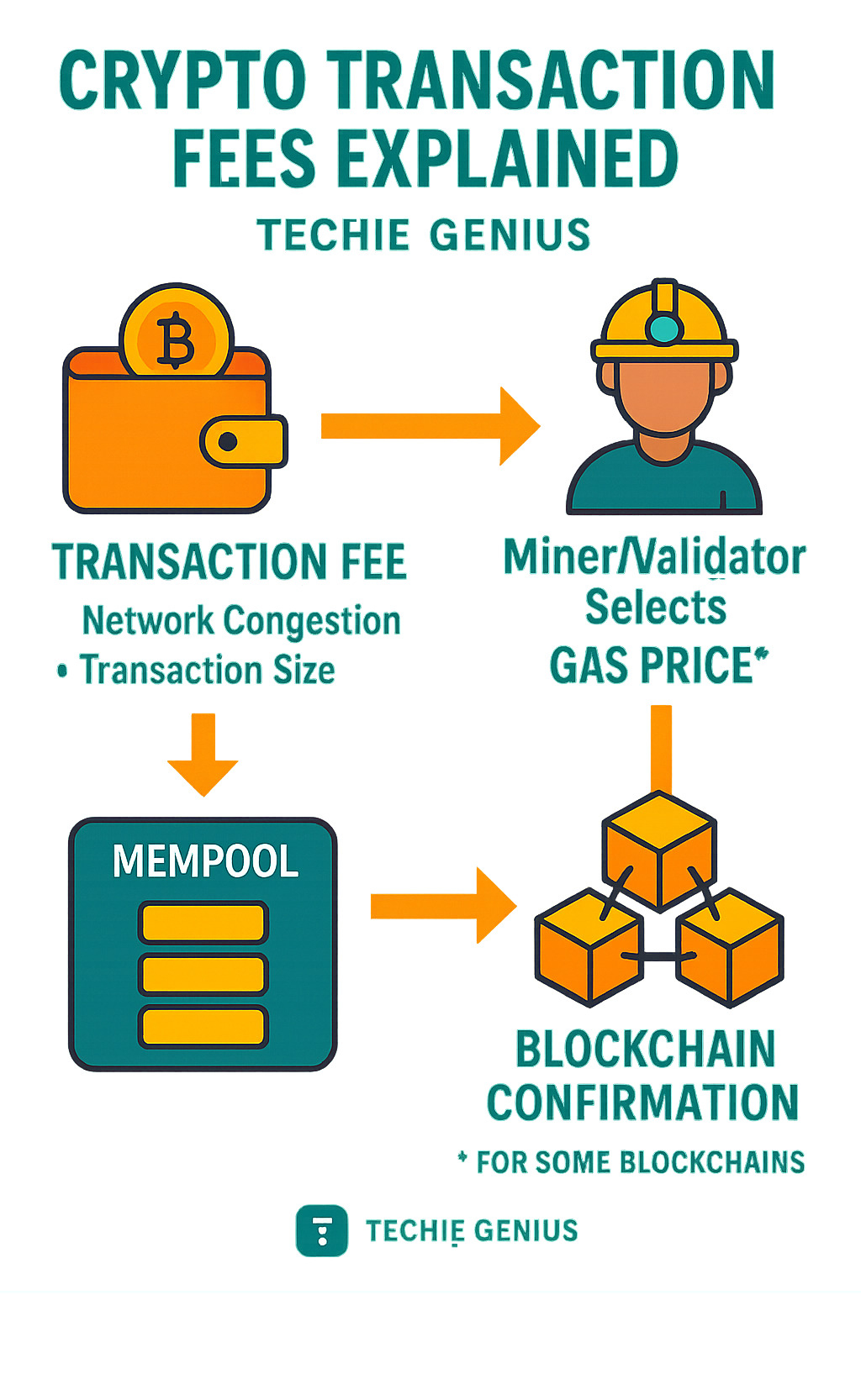
When you hit “send” on a crypto transaction, it doesn’t immediately appear on the blockchain. Instead, your transaction joins a waiting room called the mempool, where it competes with thousands of other pending transactions.
Miners and validators act like bouncers at a popular club – they decide who gets in first based on how much you’re willing to pay. Bitcoin uses a system called satoshis per virtual byte (sats/vByte) to rank transactions. Ethereum measures fees in gas, with prices quoted in Gwei (tiny fractions of ETH).
Block space limits create the scarcity that drives this auction system. Bitcoin blocks can only hold about 4 MB of transaction data, while Ethereum blocks adjust their size based on demand but maintain target processing speeds. If you set your fee too low, your transaction might sit in the mempool for hours or even days.
How Fees Differ Across Blockchains and Platforms
Here’s where crypto transaction fees explained gets interesting – every blockchain network handles fees differently, like different countries using different currencies and toll systems. Understanding these differences can save you serious money.
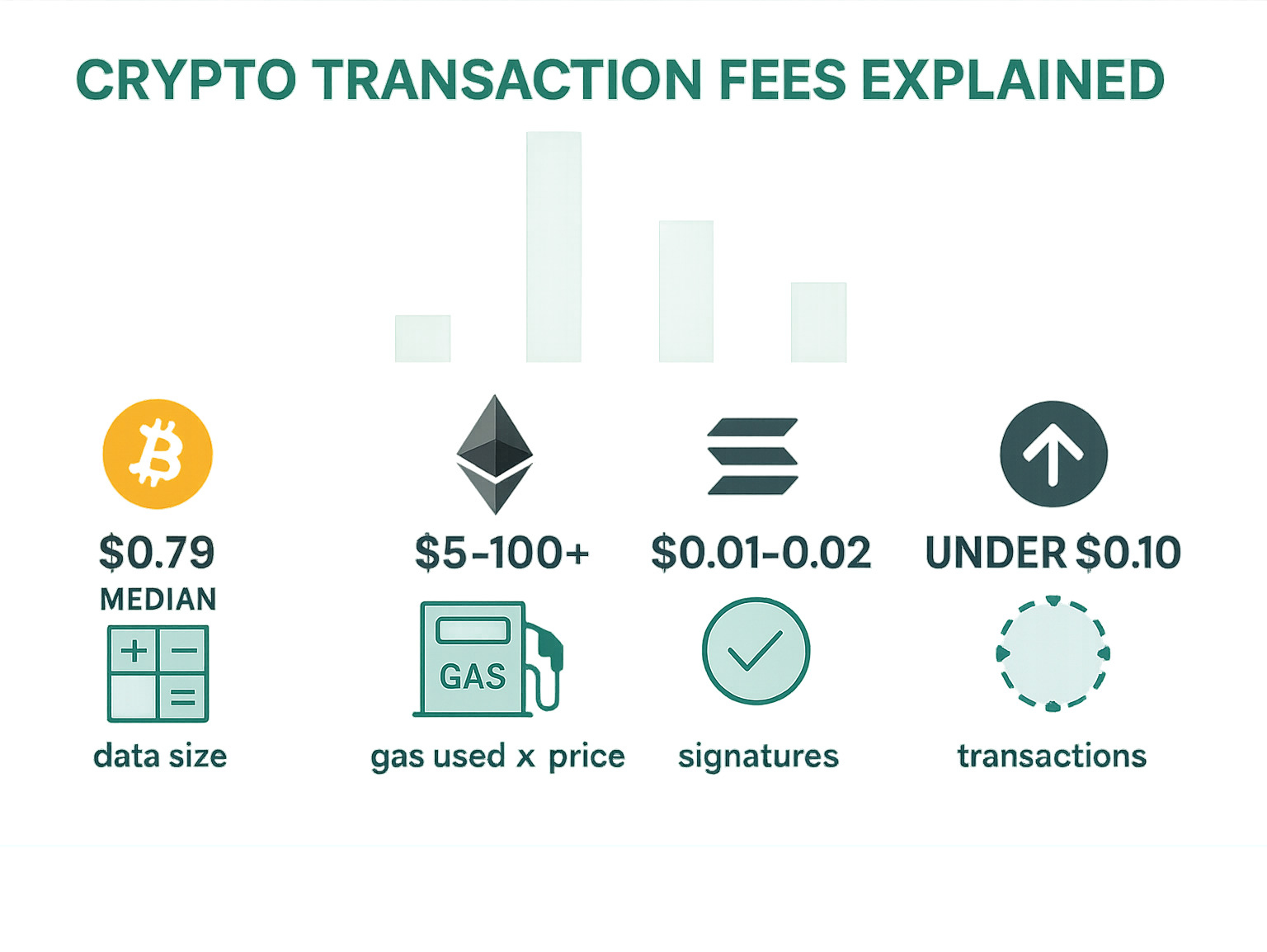
Bitcoin keeps things relatively simple with its auction-style fee market. You’re essentially bidding for space in the next block, and fees depend on how much data your transaction uses plus how many other people are trying to send Bitcoin at the same time. During quiet periods, you might pay just $0.50, but when everyone’s rushing to buy or sell, fees can spike to $30 or more.
Ethereum operates more like a complex computer where every action costs “gas.” Sending basic ETH to a friend? That’ll cost you 21,000 gas units. Want to swap tokens on a decentralized exchange? You might need 200,000 gas units or more. The total fee equals your gas usage multiplied by the current gas price.
Solana takes a completely different approach with predictable fees based on signature requirements. This usually means paying just a penny or two per transaction, making it incredibly attractive for frequent traders.
Bitcoin vs Ethereum vs Layer-2 Costs
Bitcoin’s fee structure might seem straightforward, but there are smart ways to reduce costs. SegWit addresses automatically give you a discount by separating signature data from transaction data, making your transactions smaller and cheaper.
The real game-changer for Bitcoin is the Lightning Network. Think of it as an express lane where you can send payments instantly for fees as low as 0.1% of the amount transferred. Instead of waiting for blockchain confirmation, Lightning transactions happen off-chain through payment channels.
Ethereum’s transition to Proof-of-Stake didn’t directly slash fees, but it paved the way for Layer-2 solutions that actually do. Optimism and Arbitrum process transactions off the main Ethereum chain, then batch them together for final settlement. This can reduce fees by 90% or more compared to mainnet Ethereum.
One clever cost-saving trick is payment batching. Instead of sending five separate Bitcoin transactions to different people, you can combine all five payments into one transaction. This dramatically reduces your total fee burden.
Exchange & Wallet Mark-ups
Here’s where things get tricky – exchanges add their own fees on top of network costs, and they’re not always transparent about it. Most platforms use a maker/taker fee structure where you pay less for limit orders (maker fees) that add liquidity to the order book, and more for market orders (taker fees) that remove liquidity.
The fee differences between platforms can be substantial. High-volume traders might pay as little as 0% maker fees and 0.0475% taker fees, while casual users typically pay 0.38% to 0.57% per trade.
Hidden spreads are another cost that many users miss entirely. When you buy Bitcoin, you’re paying slightly more than the “market price,” and when you sell, you receive slightly less. A $1,000 Bitcoin purchase might include a $10 spread plus an $18 fee, totaling nearly $30 in costs.
For detailed breakdowns of withdrawal costs across different platforms, check out our comprehensive guide on crypto exchange withdrawal fees.
Factors That Drive Fees Up or Down
Understanding what makes crypto transaction fees explained go up and down is like learning to read the weather patterns of the blockchain world. Just as storm systems can suddenly change your travel plans, network conditions can dramatically impact what you pay to move your digital assets.
The cryptocurrency fee landscape shifts constantly based on several key factors. Network congestion acts like rush hour traffic – when everyone wants to use the highway at once, you’ll pay more for the privilege. But unlike traditional traffic, crypto networks use an auction system where the highest bidders get priority access to the next block.
Transaction complexity plays an equally important role. Think of it like shipping packages – a simple envelope costs less than a heavy box with fragile contents. Bitcoin transactions work similarly, where the data size (not the dollar amount) determines your fee.
Transaction Size & Complexity
Here’s something that surprises many newcomers: Bitcoin transaction fees have nothing to do with how much money you’re sending. Whether you’re transferring $10 or $10 million, the fee stays the same if the transaction data is identical. This happens because Bitcoin charges based on the transaction’s size in bytes, not its value.
Multi-input Bitcoin transactions create the biggest fee headaches. When your wallet needs to combine several previous payments to fund a new transaction, each additional input adds roughly 148 bytes to the total size.
Ethereum operates on a completely different system that charges for computational work. A simple ETH transfer requires exactly 21,000 gas units, but smart contract interactions can consume hundreds of thousands of gas units. NFT minting involves multiple operations like checking ownership, updating metadata, and transferring tokens, which explains why those transactions cost significantly more.
DeFi operations represent the most complex transactions on Ethereum. When you provide liquidity to a decentralized exchange or execute a token swap, the smart contract must perform numerous calculations and database updates.
Network Demand & Timing
Smart crypto users have learned that timing can save you serious money. Network activity follows surprisingly predictable patterns, much like rush hour traffic or seasonal shopping trends. Weekends typically see lower transaction volumes across most blockchains, translating to reduced fees for patient users.
The difference between peak and off-peak pricing can be dramatic. During the NFT mania of early 2022, Ethereum gas fees temporarily spiked into the thousands of dollars per transaction as collectors rushed to mint popular collections. Meanwhile, the same transactions during quiet periods might cost under $10.
Bull market periods create perfect storms for high fees. When cryptocurrency prices surge, trading activity explodes as users rush to capitalize on price movements. This increased demand for block space drives up fees across all major networks.
Fee estimation tools like mempool.space become invaluable during volatile periods. These tools analyze current network conditions and suggest appropriate fee rates based on how quickly you need confirmation.
Consensus & Upgrade Events
The underlying technology powering different blockchains creates unique fee dynamics. Proof-of-Work networks like Bitcoin tend to have more predictable fee patterns because mining economics follow established rules.
Ethereum’s transition from Proof-of-Work to Proof-of-Stake changed the fee game entirely. While the upgrade didn’t immediately reduce transaction costs, it fundamentally altered how fees are distributed. Instead of going to energy-intensive miners, fees now reward validators who stake ETH to secure the network.
Bitcoin halving events create fascinating fee dynamics that play out over months and years. These events, occurring roughly every four years, cut the block reward in half. The 2024 halving reduced rewards from 6.25 to 3.125 BTC, making transaction fees relatively more important for miner profitability.
Strategies to Minimize Your Crypto Costs
Let’s be honest – nobody likes paying more than they have to, especially when it comes to crypto transaction fees explained. The good news? With a few smart strategies, you can dramatically cut your costs without sacrificing security or convenience.
Think of fee optimization like shopping for gas. You wouldn’t fill up at the most expensive station in town if there’s a cheaper option around the corner. The same principle applies to crypto – timing, platform choice, and knowing a few technical tricks can save you serious money.
Here’s what works: timing your transactions during off-peak hours (weekends are usually quieter), using SegWit-enabled Bitcoin addresses for automatic discounts, and batching multiple payments into single transactions when possible. On exchanges, choosing maker orders over taker orders and paying fees with native tokens like BNB on Binance can slash your costs even further.
Use Layer-2 and Alternative Chains
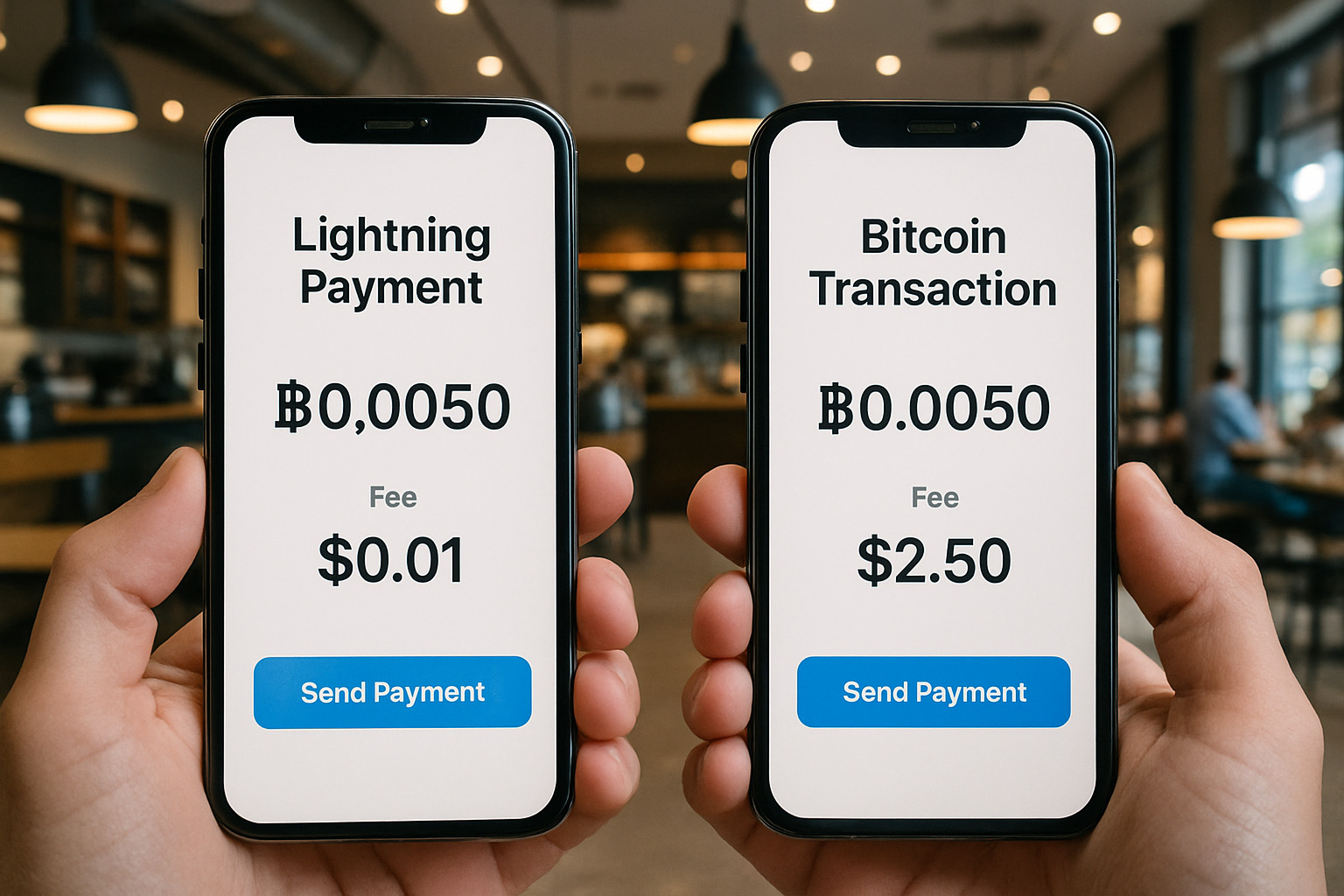
Layer-2 solutions are like express lanes for crypto transactions – faster, cheaper, and often just as secure as the main highway. The Lightning Network transforms Bitcoin payments by enabling transactions with fees as low as 0.1% of what you’re sending. That means sending $100 costs you just 10 cents instead of $2.50 on the main Bitcoin network.
Ethereum users have even more options. Optimism and Arbitrum use clever technology called optimistic rollups to process your transactions off the main chain while keeping Ethereum’s rock-solid security.
Polygon takes a slightly different approach as a sidechain with its own validators. You trade a tiny bit of security for dramatically lower fees – often just pennies per transaction.
Solana and Cosmos offer native low-fee environments from the ground up. Solana’s fees typically hover around $0.01-0.02 per transaction, regardless of how complex your transaction is.
The Arbitrum rollout shows how even big institutions are embracing these cost-saving solutions.
Optimize Wallet Settings
Your wallet is like a Swiss Army knife – it has more tools than most people realize. Instead of always clicking “fast” or “priority” for transactions, take a moment to explore the custom settings. You’ll often find you can get the same confirmation speed for half the price.
Custom gas settings on Ethereum wallets let you fine-tune both gas price and gas limit. While you should leave gas limits alone unless you really know what you’re doing, adjusting gas price based on current network conditions can save you substantial money.
Replace-by-Fee (RBF) is a lifesaver when your Bitcoin transaction gets stuck. Instead of waiting hours or days for confirmation, RBF lets you bump up the fee after you’ve already sent the transaction.
Many modern wallets now include speed-up features that handle this automatically. They monitor your transaction and offer to increase the fee if things are moving slowly.
Choose Cost-Efficient Platforms
Not all exchanges are created equal when it comes to fees. The difference between a high-fee and low-fee platform can add up to hundreds or thousands of dollars over time, especially if you trade regularly.
Maker and taker fee structures vary dramatically between platforms. Some exchanges charge maker fees as low as 0% for high-volume traders, essentially paying you to provide liquidity to their order books.
Volume-based tiers reward frequent traders with progressively lower fees. If you’re planning to trade regularly, it might make sense to concentrate your activity on one platform to reach higher tiers faster.
Internal transfers between accounts on the same exchange typically cost nothing. This makes it smart to keep some funds on platforms where you trade frequently.
For detailed comparisons of fee structures and platform recommendations, check out our comprehensive guide on the best crypto exchange options available today.
Frequently Asked Questions about Crypto Transaction Fees Explained
You’ve probably got questions about crypto transaction fees explained – and that’s totally normal! These three questions come up constantly, so let’s tackle them with straight answers.
How much does a typical Bitcoin or Ethereum transaction cost?
Here’s the thing about Bitcoin fees – they’re surprisingly affordable for most transactions. You’ll typically pay between $0.50 and $2.50, with the current median sitting around $0.79. But here’s what makes Bitcoin special: whether you’re sending $10 or $10 million, you pay the same fee if your transaction has the same data structure.
That’s because Bitcoin fees depend on how much space your transaction takes up in a block, not the dollar amount you’re moving. The median Bitcoin transaction actually moves about $2 million but only costs that $0.79 – that’s a fee rate of less than 0.00004%!
Of course, fees can spike during busy periods. Back in late 2017, when everyone was rushing to buy Bitcoin, fees hit $34 per transaction. Still cheaper than most wire transfers, but definitely noticeable.
Ethereum is a different beast entirely. Simple ETH transfers usually cost $5-15 during normal network conditions, but smart contract interactions get expensive fast. Complex DeFi operations or NFT minting can easily cost $50-200 or more.
During the crazy NFT boom in May 2022, some Ethereum transactions cost thousands of dollars. That’s when you know the network is seriously congested!
Can a transaction get stuck if I set fees too low?
Absolutely, and it’s more common than you’d think. When you set fees too low, your transaction sits in the mempool while miners and validators prioritize higher-paying transactions. It’s like being stuck in the slow lane during rush hour.
Bitcoin transactions typically get dropped from most mempools after 14 days if they don’t get confirmed. Your coins return to your wallet, but you’ve wasted time waiting. Ethereum transactions can hang around indefinitely until they’re either confirmed or you manually cancel them.
The good news? Modern wallets have your back with built-in solutions. Replace-by-Fee (RBF) lets you bump up Bitcoin transaction fees after you’ve already sent them. Most Ethereum wallets include “speed up” or “cancel” buttons that create new transactions with higher gas prices to unstick your original transaction.
Pro tip: Use fee estimation tools and check network congestion before sending urgent transactions. A little planning saves a lot of headaches.
Are crypto fees cheaper than traditional bank fees?
For large transfers and international payments, crypto fees are incredibly cheaper. Traditional remittance services can charge up to 10% per transaction, while Bitcoin charges the same few dollars whether you’re sending $100 or $100,000.
Think about international wire transfers – banks typically charge $15-50 plus exchange rate markups that can add another 2-4%. Meanwhile, that $0.79 Bitcoin transaction works the same whether you’re sending money across the street or across the globe.
But here’s the catch: for small everyday purchases, crypto fees can be proportionally expensive. A $2 Bitcoin fee on a $10 coffee represents 20% of your purchase – definitely not practical for daily spending.
This is exactly why Layer-2 solutions like Lightning Network exist. They reduce Bitcoin transaction costs to fractions of a cent, making crypto practical for everyday purchases. Similarly, using low-fee networks like Solana for routine transactions can keep your costs minimal.
The bottom line? Crypto shines for larger transfers and international payments, while traditional payment methods still make sense for small, local purchases – at least until Layer-2 adoption becomes more widespread.
Conclusion
You’ve just learned everything you need to know about crypto transaction fees explained – and honestly, that knowledge is going to save you real money. Every time you understand why fees spike during network congestion or find a Layer-2 solution that cuts your costs by 90%, you’re keeping more of your hard-earned crypto in your own wallet.
The beauty of understanding these fee structures is that network fees aren’t just random charges – they’re the economic engine that keeps blockchains secure and running smoothly. Whether it’s timing your Bitcoin transfers for weekend lulls, using Lightning Network for everyday payments, or choosing Arbitrum over mainnet Ethereum, you have options.
Different blockchains really do offer dramatically different experiences. Bitcoin’s straightforward auction model makes sense once you realize you’re bidding for precious block space. Ethereum’s gas system might seem complex, but it’s actually quite logical when you think of it as paying for computational work. And newer networks like Solana prove that crypto doesn’t have to be expensive to be secure.
The strategic optimization techniques we’ve covered aren’t just theoretical – they work in the real world. Users regularly save 50-80% on transaction costs by batching payments, using maker orders instead of taker orders, and paying attention to mempool conditions. Some save thousands of dollars annually just by switching to the right exchange fee tier or using native tokens for fee discounts.
What’s exciting is how rapidly this space continues improving. Layer-2 networks are becoming more user-friendly every month. Cross-chain bridges are getting more reliable. Even traditional wallets now include smart fee estimation that would have been cutting-edge technology just a few years ago.
Your next moves should be practical ones. Start by looking at your last few transactions – could any of them have been cheaper with better timing or platform choice? Try sending a small amount through a Layer-2 network to see how much faster and cheaper it is. Set up a bookmark to a mempool monitoring tool so you can check network conditions before making larger transfers.
Most importantly, crypto transaction fees explained isn’t just about saving money (though that’s nice). It’s about understanding how these financial systems actually work. When you know why fees exist and how they’re calculated, you’re not just a crypto user – you’re an informed participant in the future of money.
For deeper insights into the underlying technology powering these networks, check out our comprehensive guide on blockchain technology.
The crypto world moves fast, but armed with this knowledge, you’re ready to steer it efficiently and cost-effectively. Every dollar you save on fees is a dollar that can grow with your investments instead of disappearing into network costs.